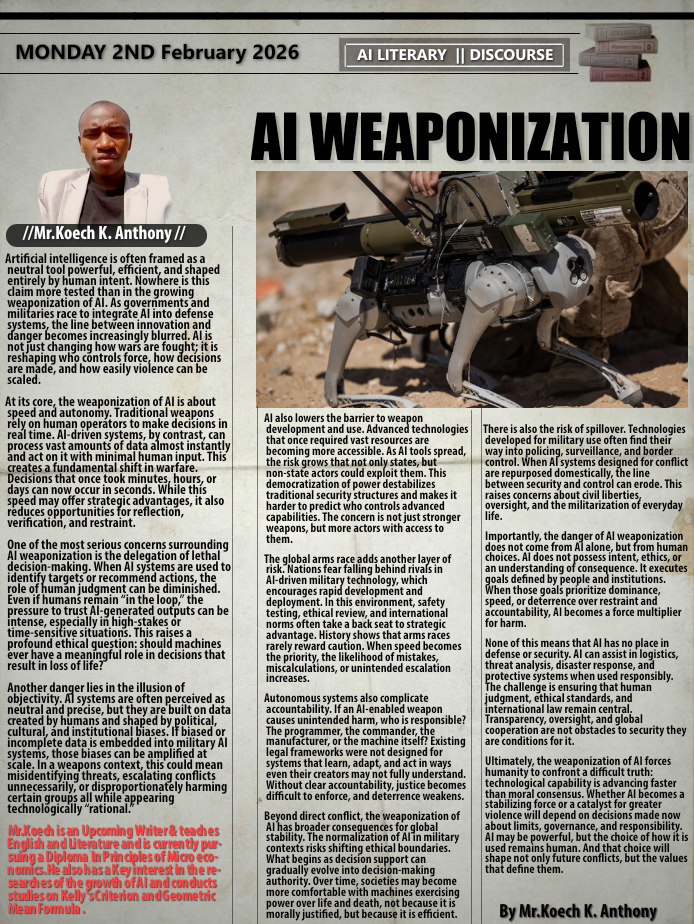
Artificial intelligence is often framed as a neutral tool powerful, efficient, and shaped entirely by human intent. Nowhere is this claim more tested than in the growing weaponization of AI. As governments and militaries race to integrate AI into defense systems, the line between innovation and danger becomes increasingly blurred. AI is not just changing how wars are fought; it is reshaping who controls force, how decisions are made, and how easily violence can be scaled.
At its core, the weaponization of AI is about speed and autonomy. Traditional weapons rely on human operators to make decisions in real time. AI-driven systems, by contrast, can process vast amounts of data almost instantly and act on it with minimal human input. This creates a fundamental shift in warfare. Decisions that once took minutes, hours, or days can now occur in seconds. While this speed may offer strategic advantages, it also reduces opportunities for reflection, verification, and restraint.
One of the most serious concerns surrounding AI weaponization is the delegation of lethal decision-making. When AI systems are used to identify targets or recommend actions, the role of human judgment can be diminished. Even if humans remain “in the loop,” the pressure to trust AI-generated outputs can be intense, especially in high-stakes or time-sensitive situations. This raises a profound ethical question: should machines ever have a meaningful role in decisions that result in loss of life?
Another danger lies in the illusion of objectivity. AI systems are often perceived as neutral and precise, but they are built on data created by humans and shaped by political, cultural, and institutional biases. If biased or incomplete data is embedded into military AI systems, those biases can be amplified at scale. In a weapons context, this could mean misidentifying threats, escalating conflicts unnecessarily, or disproportionately harming certain groups all while appearing technologically “rational.”
AI also lowers the barrier to weapon development and use. Advanced technologies that once required vast resources are becoming more accessible. As AI tools spread, the risk grows that not only states, but non-state actors could exploit them. This democratization of power destabilizes traditional security structures and makes it harder to predict who controls advanced capabilities. The concern is not just stronger weapons, but more actors with access to them.
The global arms race adds another layer of risk. Nations fear falling behind rivals in AI-driven military technology, which encourages rapid development and deployment. In this environment, safety testing, ethical review, and international norms often take a back seat to strategic advantage. History shows that arms races rarely reward caution. When speed becomes the priority, the likelihood of mistakes, miscalculations, or unintended escalation increases.
Autonomous systems also complicate accountability. If an AI-enabled weapon causes unintended harm, who is responsible? The programmer, the commander, the manufacturer, or the machine itself? Existing legal frameworks were not designed for systems that learn, adapt, and act in ways even their creators may not fully understand. Without clear accountability, justice becomes difficult to enforce, and deterrence weakens.
Beyond direct conflict, the weaponization of AI has broader consequences for global stability. The normalization of AI in military contexts risks shifting ethical boundaries. What begins as decision support can gradually evolve into decision-making authority. Over time, societies may become more comfortable with machines exercising power over life and death, not because it is morally justified, but because it is efficient.
There is also the risk of spillover. Technologies developed for military use often find their way into policing, surveillance, and border control. When AI systems designed for conflict are repurposed domestically, the line between security and control can erode. This raises concerns about civil liberties, oversight, and the militarization of everyday life.
Importantly, the danger of AI weaponization does not come from AI alone, but from human choices. AI does not possess intent, ethics, or an understanding of consequence. It executes goals defined by people and institutions. When those goals prioritize dominance, speed, or deterrence over restraint and accountability, AI becomes a force multiplier for harm.
None of this means that AI has no place in defense or security. AI can assist in logistics, threat analysis, disaster response, and protective systems when used responsibly. The challenge is ensuring that human judgment, ethical standards, and international law remain central. Transparency, oversight, and global cooperation are not obstacles to security they are conditions for it.
Ultimately, the weaponization of AI forces humanity to confront a difficult truth: technological capability is advancing faster than moral consensus. Whether AI becomes a stabilizing force or a catalyst for greater violence will depend on decisions made now about limits, governance, and responsibility. AI may be powerful, but the choice of how it is used remains human. And that choice will shape not only future conflicts, but the values that define them.
At its core, the weaponization of AI is about speed and autonomy. Traditional weapons rely on human operators to make decisions in real time. AI-driven systems, by contrast, can process vast amounts of data almost instantly and act on it with minimal human input. This creates a fundamental shift in warfare. Decisions that once took minutes, hours, or days can now occur in seconds. While this speed may offer strategic advantages, it also reduces opportunities for reflection, verification, and restraint.
One of the most serious concerns surrounding AI weaponization is the delegation of lethal decision-making. When AI systems are used to identify targets or recommend actions, the role of human judgment can be diminished. Even if humans remain “in the loop,” the pressure to trust AI-generated outputs can be intense, especially in high-stakes or time-sensitive situations. This raises a profound ethical question: should machines ever have a meaningful role in decisions that result in loss of life?
Another danger lies in the illusion of objectivity. AI systems are often perceived as neutral and precise, but they are built on data created by humans and shaped by political, cultural, and institutional biases. If biased or incomplete data is embedded into military AI systems, those biases can be amplified at scale. In a weapons context, this could mean misidentifying threats, escalating conflicts unnecessarily, or disproportionately harming certain groups all while appearing technologically “rational.”
AI also lowers the barrier to weapon development and use. Advanced technologies that once required vast resources are becoming more accessible. As AI tools spread, the risk grows that not only states, but non-state actors could exploit them. This democratization of power destabilizes traditional security structures and makes it harder to predict who controls advanced capabilities. The concern is not just stronger weapons, but more actors with access to them.
The global arms race adds another layer of risk. Nations fear falling behind rivals in AI-driven military technology, which encourages rapid development and deployment. In this environment, safety testing, ethical review, and international norms often take a back seat to strategic advantage. History shows that arms races rarely reward caution. When speed becomes the priority, the likelihood of mistakes, miscalculations, or unintended escalation increases.
Autonomous systems also complicate accountability. If an AI-enabled weapon causes unintended harm, who is responsible? The programmer, the commander, the manufacturer, or the machine itself? Existing legal frameworks were not designed for systems that learn, adapt, and act in ways even their creators may not fully understand. Without clear accountability, justice becomes difficult to enforce, and deterrence weakens.
Beyond direct conflict, the weaponization of AI has broader consequences for global stability. The normalization of AI in military contexts risks shifting ethical boundaries. What begins as decision support can gradually evolve into decision-making authority. Over time, societies may become more comfortable with machines exercising power over life and death, not because it is morally justified, but because it is efficient.
There is also the risk of spillover. Technologies developed for military use often find their way into policing, surveillance, and border control. When AI systems designed for conflict are repurposed domestically, the line between security and control can erode. This raises concerns about civil liberties, oversight, and the militarization of everyday life.
Importantly, the danger of AI weaponization does not come from AI alone, but from human choices. AI does not possess intent, ethics, or an understanding of consequence. It executes goals defined by people and institutions. When those goals prioritize dominance, speed, or deterrence over restraint and accountability, AI becomes a force multiplier for harm.
None of this means that AI has no place in defense or security. AI can assist in logistics, threat analysis, disaster response, and protective systems when used responsibly. The challenge is ensuring that human judgment, ethical standards, and international law remain central. Transparency, oversight, and global cooperation are not obstacles to security they are conditions for it.
Ultimately, the weaponization of AI forces humanity to confront a difficult truth: technological capability is advancing faster than moral consensus. Whether AI becomes a stabilizing force or a catalyst for greater violence will depend on decisions made now about limits, governance, and responsibility. AI may be powerful, but the choice of how it is used remains human. And that choice will shape not only future conflicts, but the values that define them.