Culture in the Age of Code: Identity, Memory, and Meaning in a Digital Kenya
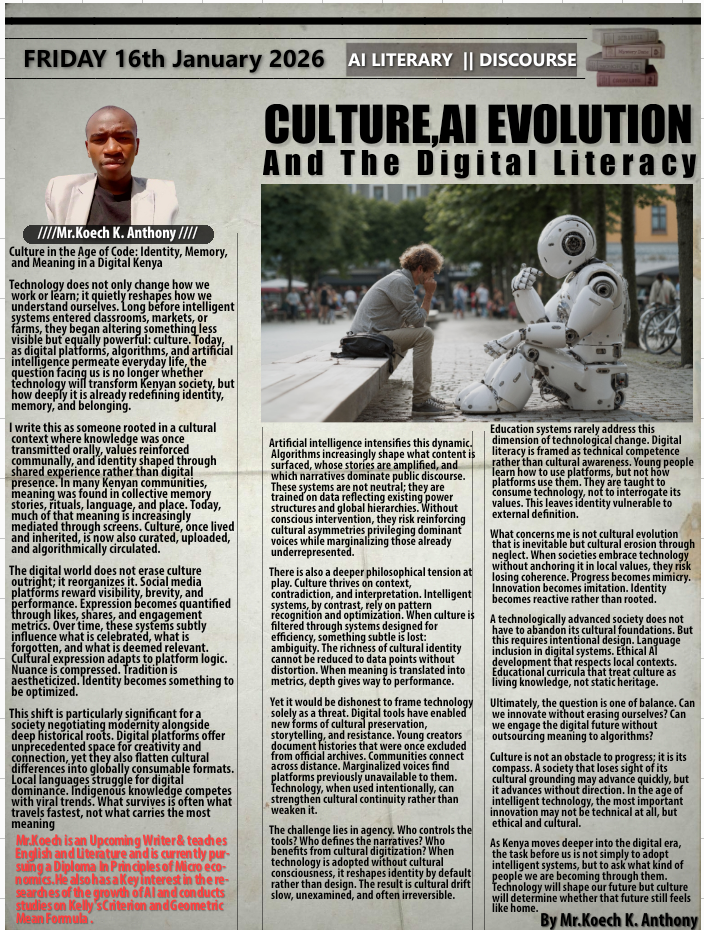
Technology does not only change how we work or learn; it quietly reshapes how we understand ourselves. Long before intelligent systems entered classrooms, markets, or farms, they began altering something less visible but equally powerful: culture. Today, as digital platforms, algorithms, and artificial intelligence permeate everyday life, the question facing us is no longer whether technology will transform Kenyan society, but how deeply it is already redefining identity, memory, and belonging.
I write this as someone rooted in a cultural context where knowledge was once transmitted orally, values reinforced communally, and identity shaped through shared experience rather than digital presence. In many Kenyan communities, meaning was found in collective memory stories, rituals, language, and place. Today, much of that meaning is increasingly mediated through screens. Culture, once lived and inherited, is now also curated, uploaded, and algorithmically circulated.
The digital world does not erase culture outright; it reorganizes it. Social media platforms reward visibility, brevity, and performance. Expression becomes quantified through likes, shares, and engagement metrics. Over time, these systems subtly influence what is celebrated, what is forgotten, and what is deemed relevant. Cultural expression adapts to platform logic. Nuance is compressed. Tradition is aestheticized. Identity becomes something to be optimized.
This shift is particularly significant for a society negotiating modernity alongside deep historical roots. Digital platforms offer unprecedented space for creativity and connection, yet they also flatten cultural differences into globally consumable formats. Local languages struggle for digital dominance. Indigenous knowledge competes with viral trends. What survives is often what travels fastest, not what carries the most meaning.
Artificial intelligence intensifies this dynamic. Algorithms increasingly shape what content is surfaced, whose stories are amplified, and which narratives dominate public discourse. These systems are not neutral; they are trained on data reflecting existing power structures and global hierarchies. Without conscious intervention, they risk reinforcing cultural asymmetries privileging dominant voices while marginalizing those already underrepresented.
There is also a deeper philosophical tension at play. Culture thrives on context, contradiction, and interpretation. Intelligent systems, by contrast, rely on pattern recognition and optimization. When culture is filtered through systems designed for efficiency, something subtle is lost: ambiguity. The richness of cultural identity cannot be reduced to data points without distortion. When meaning is translated into metrics, depth gives way to performance.
Yet it would be dishonest to frame technology solely as a threat. Digital tools have enabled new forms of cultural preservation, storytelling, and resistance. Young creators document histories that were once excluded from official archives. Communities connect across distance. Marginalized voices find platforms previously unavailable to them. Technology, when used intentionally, can strengthen cultural continuity rather than weaken it.
The challenge lies in agency. Who controls the tools? Who defines the narratives? Who benefits from cultural digitization? When technology is adopted without cultural consciousness, it reshapes identity by default rather than design. The result is cultural drift slow, unexamined, and often irreversible.
Education systems rarely address this dimension of technological change. Digital literacy is framed as technical competence rather than cultural awareness. Young people learn how to use platforms, but not how platforms use them. They are taught to consume technology, not to interrogate its values. This leaves identity vulnerable to external definition.
What concerns me is not cultural evolution that is inevitable but cultural erosion through neglect. When societies embrace technology without anchoring it in local values, they risk losing coherence. Progress becomes mimicry. Innovation becomes imitation. Identity becomes reactive rather than rooted.
A technologically advanced society does not have to abandon its cultural foundations. But this requires intentional design. Language inclusion in digital systems. Ethical AI development that respects local contexts. Educational curricula that treat culture as living knowledge, not static heritage. Technology should extend cultural memory, not overwrite it.
Ultimately, the question is one of balance. Can we innovate without erasing ourselves? Can we engage the digital future without outsourcing meaning to algorithms? Can technology serve culture rather than subsume it?
Culture is not an obstacle to progress; it is its compass. A society that loses sight of its cultural grounding may advance quickly, but it advances without direction. In the age of intelligent technology, the most important innovation may not be technical at all, but ethical and cultural.
As Kenya moves deeper into the digital era, the task before us is not simply to adopt intelligent systems, but to ask what kind of people we are becoming through them. Technology will shape our future but culture will determine whether that future still feels like home.
Technology does not only change how we work or learn; it quietly reshapes how we understand ourselves. Long before intelligent systems entered classrooms, markets, or farms, they began altering something less visible but equally powerful: culture. Today, as digital platforms, algorithms, and artificial intelligence permeate everyday life, the question facing us is no longer whether technology will transform Kenyan society, but how deeply it is already redefining identity, memory, and belonging.
I write this as someone rooted in a cultural context where knowledge was once transmitted orally, values reinforced communally, and identity shaped through shared experience rather than digital presence. In many Kenyan communities, meaning was found in collective memory stories, rituals, language, and place. Today, much of that meaning is increasingly mediated through screens. Culture, once lived and inherited, is now also curated, uploaded, and algorithmically circulated.
The digital world does not erase culture outright; it reorganizes it. Social media platforms reward visibility, brevity, and performance. Expression becomes quantified through likes, shares, and engagement metrics. Over time, these systems subtly influence what is celebrated, what is forgotten, and what is deemed relevant. Cultural expression adapts to platform logic. Nuance is compressed. Tradition is aestheticized. Identity becomes something to be optimized.
This shift is particularly significant for a society negotiating modernity alongside deep historical roots. Digital platforms offer unprecedented space for creativity and connection, yet they also flatten cultural differences into globally consumable formats. Local languages struggle for digital dominance. Indigenous knowledge competes with viral trends. What survives is often what travels fastest, not what carries the most meaning.
Artificial intelligence intensifies this dynamic. Algorithms increasingly shape what content is surfaced, whose stories are amplified, and which narratives dominate public discourse. These systems are not neutral; they are trained on data reflecting existing power structures and global hierarchies. Without conscious intervention, they risk reinforcing cultural asymmetries privileging dominant voices while marginalizing those already underrepresented.
There is also a deeper philosophical tension at play. Culture thrives on context, contradiction, and interpretation. Intelligent systems, by contrast, rely on pattern recognition and optimization. When culture is filtered through systems designed for efficiency, something subtle is lost: ambiguity. The richness of cultural identity cannot be reduced to data points without distortion. When meaning is translated into metrics, depth gives way to performance.
Yet it would be dishonest to frame technology solely as a threat. Digital tools have enabled new forms of cultural preservation, storytelling, and resistance. Young creators document histories that were once excluded from official archives. Communities connect across distance. Marginalized voices find platforms previously unavailable to them. Technology, when used intentionally, can strengthen cultural continuity rather than weaken it.
The challenge lies in agency. Who controls the tools? Who defines the narratives? Who benefits from cultural digitization? When technology is adopted without cultural consciousness, it reshapes identity by default rather than design. The result is cultural drift slow, unexamined, and often irreversible.
Education systems rarely address this dimension of technological change. Digital literacy is framed as technical competence rather than cultural awareness. Young people learn how to use platforms, but not how platforms use them. They are taught to consume technology, not to interrogate its values. This leaves identity vulnerable to external definition.
What concerns me is not cultural evolution that is inevitable but cultural erosion through neglect. When societies embrace technology without anchoring it in local values, they risk losing coherence. Progress becomes mimicry. Innovation becomes imitation. Identity becomes reactive rather than rooted.
A technologically advanced society does not have to abandon its cultural foundations. But this requires intentional design. Language inclusion in digital systems. Ethical AI development that respects local contexts. Educational curricula that treat culture as living knowledge, not static heritage. Technology should extend cultural memory, not overwrite it.
Ultimately, the question is one of balance. Can we innovate without erasing ourselves? Can we engage the digital future without outsourcing meaning to algorithms? Can technology serve culture rather than subsume it?
Culture is not an obstacle to progress; it is its compass. A society that loses sight of its cultural grounding may advance quickly, but it advances without direction. In the age of intelligent technology, the most important innovation may not be technical at all, but ethical and cultural.
As Kenya moves deeper into the digital era, the task before us is not simply to adopt intelligent systems, but to ask what kind of people we are becoming through them. Technology will shape our future but culture will determine whether that future still feels like home.