At the most recent World Economic Forum, artificial intelligence was no longer framed as a future possibility. It was discussed as a present force already reshaping global economic foundations. The tone of the conversations reflected a clear shift. Leaders were not debating whether AI would change the economy, but how deeply and how unevenly that change would unfold.
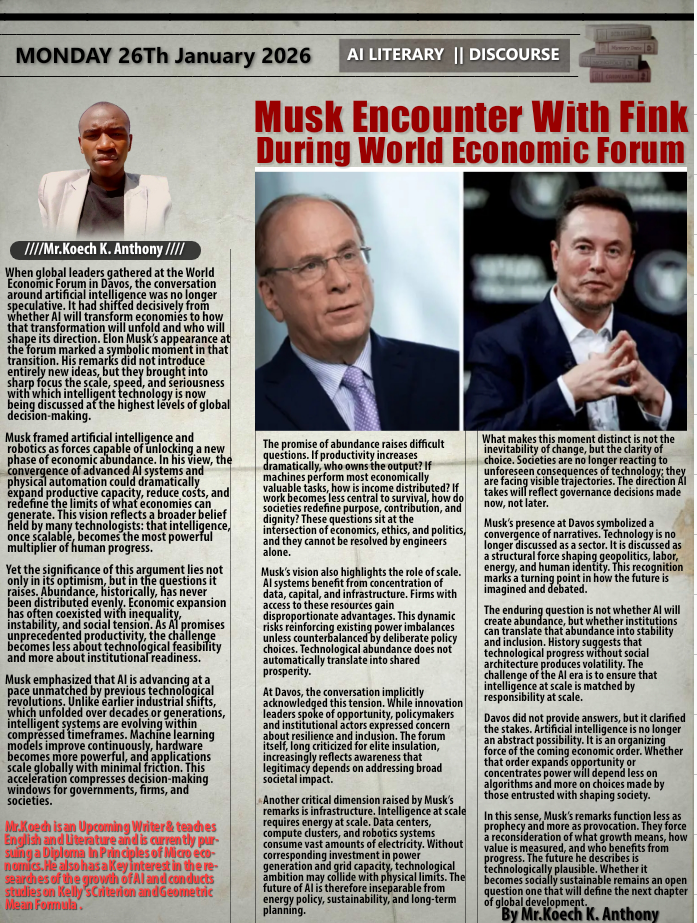
Elon Musk’s contribution to the forum echoed a view increasingly shared among technologists: that artificial intelligence, combined with robotics and energy systems, has the potential to expand economic output beyond historical limits. In this framing, intelligence becomes a scalable input, much like electricity once was. When intelligence is abundant, productivity accelerates, costs fall, and entirely new economic structures become possible.
However, this vision of abundance was not presented in isolation. Across panels and discussions, financial leaders, policymakers, and institutional investors emphasized that growth alone does not define economic success. Figures such as Larry Fink have consistently argued that markets function best when long-term stability, inclusion, and trust are protected. At Davos, this perspective served as an important counterbalance to purely technological optimism.
The core economic promise of AI lies in efficiency. Intelligent systems reduce friction in decision-making, optimize supply chains, automate complex analysis, and accelerate innovation across sectors. Industries such as finance, manufacturing, healthcare, logistics, and energy are already seeing measurable gains. These efficiencies can lower costs and expand access, especially in economies that have struggled with structural bottlenecks.
Yet efficiency has never been a neutral force. Historically, productivity gains have often concentrated wealth before redistributing it. This concern was central to the forum’s economic discussions. AI systems tend to reward scale, data access, and capital intensity. Without intervention, they risk amplifying existing inequalities between firms, regions, and nations.
Musk’s view reflects the technological frontier, where intelligence becomes cheaper and more capable over time. Financial leaders, by contrast, tend to focus on systemic resilience. Larry Fink and others have emphasized that markets rely on social stability, predictable institutions, and public trust. An economy that grows rapidly while undermining employment security, income distribution, or social cohesion ultimately weakens its own foundation.
One of the most striking themes at the forum was the speed of change. Artificial intelligence evolves faster than traditional policy cycles. Regulations, education systems, and labor markets are struggling to adapt. This creates a mismatch between what technology enables and what societies are prepared to absorb. Economic disruption, in this context, is not hypothetical; it is already visible in workforce transitions and shifting capital flows.
Another key issue raised was ownership. AI-driven value often accumulates where data, infrastructure, and intellectual property are concentrated. This dynamic raises questions about who benefits from global productivity gains. Developing economies, in particular, face the risk of becoming consumers rather than owners of intelligent systems unless deliberate investment and policy strategies are adopted.
Energy also featured prominently in discussions about AI’s economic future. Intelligent systems require vast computational power, which in turn demands reliable and scalable energy infrastructure. Musk has repeatedly highlighted this constraint, and it was echoed across the forum. Economic growth driven by AI will be limited unless energy production, grid resilience, and sustainability advance in parallel.
Beyond infrastructure, the forum highlighted a deeper concern: the meaning of economic contribution. As AI systems take on more analytical and operational roles, traditional measures of productivity and employment become less sufficient. Leaders acknowledged that societies may need to rethink how value is defined, how income is distributed, and how human contribution is recognized beyond output alone.
Financial markets are already adjusting. Capital is flowing toward firms that integrate AI effectively, while long-term investors increasingly assess governance, ethics, and risk management alongside innovation. This reflects an understanding that unchecked technological acceleration introduces systemic risk. Growth that ignores social impact can destabilize markets rather than strengthen them.
Importantly, the forum did not frame AI as an enemy of labor, but as a force that requires coordination. Education systems, workforce training, and institutional design were repeatedly cited as decisive factors. Economies that invest in human adaptability are better positioned to convert technological change into shared prosperity.
Musk’s vision of abundance highlights what is technologically possible. The broader Davos conversation addressed what is economically sustainable. These perspectives are not opposed; they are incomplete without each other. Technology can expand the frontier of growth, but institutions determine how that growth is distributed and whether it endures.
The emerging consensus is cautious but clear. Artificial intelligence will reshape global economics by altering productivity, ownership, and the structure of work. It will reward preparedness and punish inertia. Countries and institutions that fail to align governance with innovation risk widening inequality and social strain.
The future of the global economy will not be decided by AI alone. It will be shaped by how intelligence is governed, how markets are structured, and how societies choose to balance efficiency with inclusion. Davos made one point unmistakable: technological capability has outpaced economic imagination, and closing that gap is now the defining challenge.
Artificial intelligence may transform what economies can produce. Whether it strengthens or destabilizes them will depend on choices made far beyond the laboratory or the boardroom. Growth is no longer the only metric. Stability, trust, and shared opportunity have become equally central to the economic future now being written.
Elon Musk’s contribution to the forum echoed a view increasingly shared among technologists: that artificial intelligence, combined with robotics and energy systems, has the potential to expand economic output beyond historical limits. In this framing, intelligence becomes a scalable input, much like electricity once was. When intelligence is abundant, productivity accelerates, costs fall, and entirely new economic structures become possible.
However, this vision of abundance was not presented in isolation. Across panels and discussions, financial leaders, policymakers, and institutional investors emphasized that growth alone does not define economic success. Figures such as Larry Fink have consistently argued that markets function best when long-term stability, inclusion, and trust are protected. At Davos, this perspective served as an important counterbalance to purely technological optimism.
The core economic promise of AI lies in efficiency. Intelligent systems reduce friction in decision-making, optimize supply chains, automate complex analysis, and accelerate innovation across sectors. Industries such as finance, manufacturing, healthcare, logistics, and energy are already seeing measurable gains. These efficiencies can lower costs and expand access, especially in economies that have struggled with structural bottlenecks.
Yet efficiency has never been a neutral force. Historically, productivity gains have often concentrated wealth before redistributing it. This concern was central to the forum’s economic discussions. AI systems tend to reward scale, data access, and capital intensity. Without intervention, they risk amplifying existing inequalities between firms, regions, and nations.
Musk’s view reflects the technological frontier, where intelligence becomes cheaper and more capable over time. Financial leaders, by contrast, tend to focus on systemic resilience. Larry Fink and others have emphasized that markets rely on social stability, predictable institutions, and public trust. An economy that grows rapidly while undermining employment security, income distribution, or social cohesion ultimately weakens its own foundation.
One of the most striking themes at the forum was the speed of change. Artificial intelligence evolves faster than traditional policy cycles. Regulations, education systems, and labor markets are struggling to adapt. This creates a mismatch between what technology enables and what societies are prepared to absorb. Economic disruption, in this context, is not hypothetical; it is already visible in workforce transitions and shifting capital flows.
Another key issue raised was ownership. AI-driven value often accumulates where data, infrastructure, and intellectual property are concentrated. This dynamic raises questions about who benefits from global productivity gains. Developing economies, in particular, face the risk of becoming consumers rather than owners of intelligent systems unless deliberate investment and policy strategies are adopted.
Energy also featured prominently in discussions about AI’s economic future. Intelligent systems require vast computational power, which in turn demands reliable and scalable energy infrastructure. Musk has repeatedly highlighted this constraint, and it was echoed across the forum. Economic growth driven by AI will be limited unless energy production, grid resilience, and sustainability advance in parallel.
Beyond infrastructure, the forum highlighted a deeper concern: the meaning of economic contribution. As AI systems take on more analytical and operational roles, traditional measures of productivity and employment become less sufficient. Leaders acknowledged that societies may need to rethink how value is defined, how income is distributed, and how human contribution is recognized beyond output alone.
Financial markets are already adjusting. Capital is flowing toward firms that integrate AI effectively, while long-term investors increasingly assess governance, ethics, and risk management alongside innovation. This reflects an understanding that unchecked technological acceleration introduces systemic risk. Growth that ignores social impact can destabilize markets rather than strengthen them.
Importantly, the forum did not frame AI as an enemy of labor, but as a force that requires coordination. Education systems, workforce training, and institutional design were repeatedly cited as decisive factors. Economies that invest in human adaptability are better positioned to convert technological change into shared prosperity.
Musk’s vision of abundance highlights what is technologically possible. The broader Davos conversation addressed what is economically sustainable. These perspectives are not opposed; they are incomplete without each other. Technology can expand the frontier of growth, but institutions determine how that growth is distributed and whether it endures.
The emerging consensus is cautious but clear. Artificial intelligence will reshape global economics by altering productivity, ownership, and the structure of work. It will reward preparedness and punish inertia. Countries and institutions that fail to align governance with innovation risk widening inequality and social strain.
The future of the global economy will not be decided by AI alone. It will be shaped by how intelligence is governed, how markets are structured, and how societies choose to balance efficiency with inclusion. Davos made one point unmistakable: technological capability has outpaced economic imagination, and closing that gap is now the defining challenge.
Artificial intelligence may transform what economies can produce. Whether it strengthens or destabilizes them will depend on choices made far beyond the laboratory or the boardroom. Growth is no longer the only metric. Stability, trust, and shared opportunity have become equally central to the economic future now being written.