I have always understood the service industry as human work at its core. It is the kind of work that depends on presence, attention, and response. Whether in hospitality, customer care, retail, transport, or administration, service has traditionally meant showing up for people and meeting their needs in real time. For a long time, value in this space was measured by consistency, courtesy, and reliability.
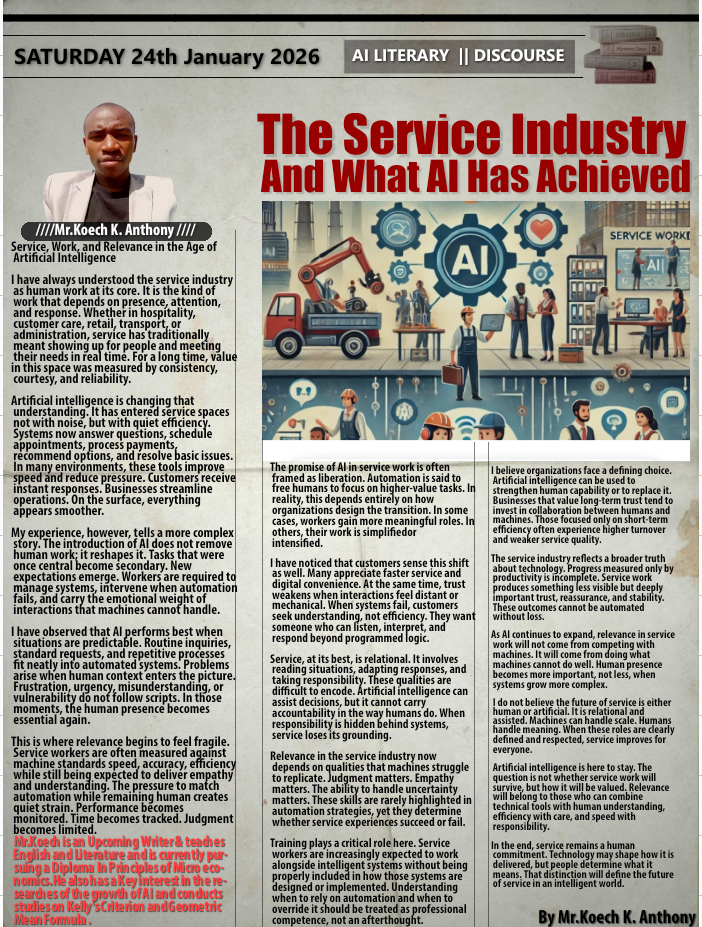
Artificial intelligence is changing that understanding. It has entered service spaces not with noise, but with quiet efficiency. Systems now answer questions, schedule appointments, process payments, recommend options, and resolve basic issues. In many environments, these tools improve speed and reduce pressure. Customers receive instant responses. Businesses streamline operations. On the surface, everything appears smoother.
My experience, however, tells a more complex story. The introduction of AI does not remove human work; it reshapes it. Tasks that were once central become secondary. New expectations emerge. Workers are required to manage systems, intervene when automation fails, and carry the emotional weight of interactions that machines cannot handle.
I have observed that AI performs best when situations are predictable. Routine inquiries, standard requests, and repetitive processes fit neatly into automated systems. Problems arise when human context enters the picture. Frustration, urgency, misunderstanding, or vulnerability do not follow scripts. In those moments, the human presence becomes essential again.
This is where relevance begins to feel fragile. Service workers are often measured against machine standards speed, accuracy, efficiency while still being expected to deliver empathy and understanding. The pressure to match automation while remaining human creates quiet strain. Performance becomes monitored. Time becomes tracked. Judgment becomes limited.
The promise of AI in service work is often framed as liberation. Automation is said to free humans to focus on higher-value tasks. In reality, this depends entirely on how organizations design the transition. In some cases, workers gain more meaningful roles. In others, their work is simplified, deskilled, or intensified.
I have noticed that customers sense this shift as well. Many appreciate faster service and digital convenience. At the same time, trust weakens when interactions feel distant or mechanical. When systems fail, customers seek understanding, not efficiency. They want someone who can listen, interpret, and respond beyond programmed logic.
Service, at its best, is relational. It involves reading situations, adapting responses, and taking responsibility. These qualities are difficult to encode. Artificial intelligence can assist decisions, but it cannot carry accountability in the way humans do. When responsibility is hidden behind systems, service loses its grounding.
Relevance in the service industry now depends on qualities that machines struggle to replicate. Judgment matters. Empathy matters. The ability to handle uncertainty matters. These skills are rarely highlighted in automation strategies, yet they determine whether service experiences succeed or fail.
Training plays a critical role here. Service workers are increasingly expected to work alongside intelligent systems without being properly included in how those systems are designed or implemented. Understanding when to rely on automation and when to override it should be treated as professional competence, not an afterthought.
I believe organizations face a defining choice. Artificial intelligence can be used to strengthen human capability or to replace it. Businesses that value long-term trust tend to invest in collaboration between humans and machines. Those focused only on short-term efficiency often experience higher turnover and weaker service quality.
The service industry reflects a broader truth about technology. Progress measured only by productivity is incomplete. Service work produces something less visible but deeply important trust, reassurance, and stability. These outcomes cannot be automated without loss.
As AI continues to expand, relevance in service work will not come from competing with machines. It will come from doing what machines cannot do well. Human presence becomes more important, not less, when systems grow more complex.
I do not believe the future of service is either human or artificial. It is relational and assisted. Machines can handle scale. Humans handle meaning. When these roles are clearly defined and respected, service improves for everyone.
Artificial intelligence is here to stay. The question is not whether service work will survive, but how it will be valued. Relevance will belong to those who can combine technical tools with human understanding, efficiency with care, and speed with responsibility.
In the end, service remains a human commitment. Technology may shape how it is delivered, but people determine what it means. That distinction will define the future of service in an intelligent world.
Artificial intelligence is changing that understanding. It has entered service spaces not with noise, but with quiet efficiency. Systems now answer questions, schedule appointments, process payments, recommend options, and resolve basic issues. In many environments, these tools improve speed and reduce pressure. Customers receive instant responses. Businesses streamline operations. On the surface, everything appears smoother.
My experience, however, tells a more complex story. The introduction of AI does not remove human work; it reshapes it. Tasks that were once central become secondary. New expectations emerge. Workers are required to manage systems, intervene when automation fails, and carry the emotional weight of interactions that machines cannot handle.
I have observed that AI performs best when situations are predictable. Routine inquiries, standard requests, and repetitive processes fit neatly into automated systems. Problems arise when human context enters the picture. Frustration, urgency, misunderstanding, or vulnerability do not follow scripts. In those moments, the human presence becomes essential again.
This is where relevance begins to feel fragile. Service workers are often measured against machine standards speed, accuracy, efficiency while still being expected to deliver empathy and understanding. The pressure to match automation while remaining human creates quiet strain. Performance becomes monitored. Time becomes tracked. Judgment becomes limited.
The promise of AI in service work is often framed as liberation. Automation is said to free humans to focus on higher-value tasks. In reality, this depends entirely on how organizations design the transition. In some cases, workers gain more meaningful roles. In others, their work is simplified, deskilled, or intensified.
I have noticed that customers sense this shift as well. Many appreciate faster service and digital convenience. At the same time, trust weakens when interactions feel distant or mechanical. When systems fail, customers seek understanding, not efficiency. They want someone who can listen, interpret, and respond beyond programmed logic.
Service, at its best, is relational. It involves reading situations, adapting responses, and taking responsibility. These qualities are difficult to encode. Artificial intelligence can assist decisions, but it cannot carry accountability in the way humans do. When responsibility is hidden behind systems, service loses its grounding.
Relevance in the service industry now depends on qualities that machines struggle to replicate. Judgment matters. Empathy matters. The ability to handle uncertainty matters. These skills are rarely highlighted in automation strategies, yet they determine whether service experiences succeed or fail.
Training plays a critical role here. Service workers are increasingly expected to work alongside intelligent systems without being properly included in how those systems are designed or implemented. Understanding when to rely on automation and when to override it should be treated as professional competence, not an afterthought.
I believe organizations face a defining choice. Artificial intelligence can be used to strengthen human capability or to replace it. Businesses that value long-term trust tend to invest in collaboration between humans and machines. Those focused only on short-term efficiency often experience higher turnover and weaker service quality.
The service industry reflects a broader truth about technology. Progress measured only by productivity is incomplete. Service work produces something less visible but deeply important trust, reassurance, and stability. These outcomes cannot be automated without loss.
As AI continues to expand, relevance in service work will not come from competing with machines. It will come from doing what machines cannot do well. Human presence becomes more important, not less, when systems grow more complex.
I do not believe the future of service is either human or artificial. It is relational and assisted. Machines can handle scale. Humans handle meaning. When these roles are clearly defined and respected, service improves for everyone.
Artificial intelligence is here to stay. The question is not whether service work will survive, but how it will be valued. Relevance will belong to those who can combine technical tools with human understanding, efficiency with care, and speed with responsibility.
In the end, service remains a human commitment. Technology may shape how it is delivered, but people determine what it means. That distinction will define the future of service in an intelligent world.