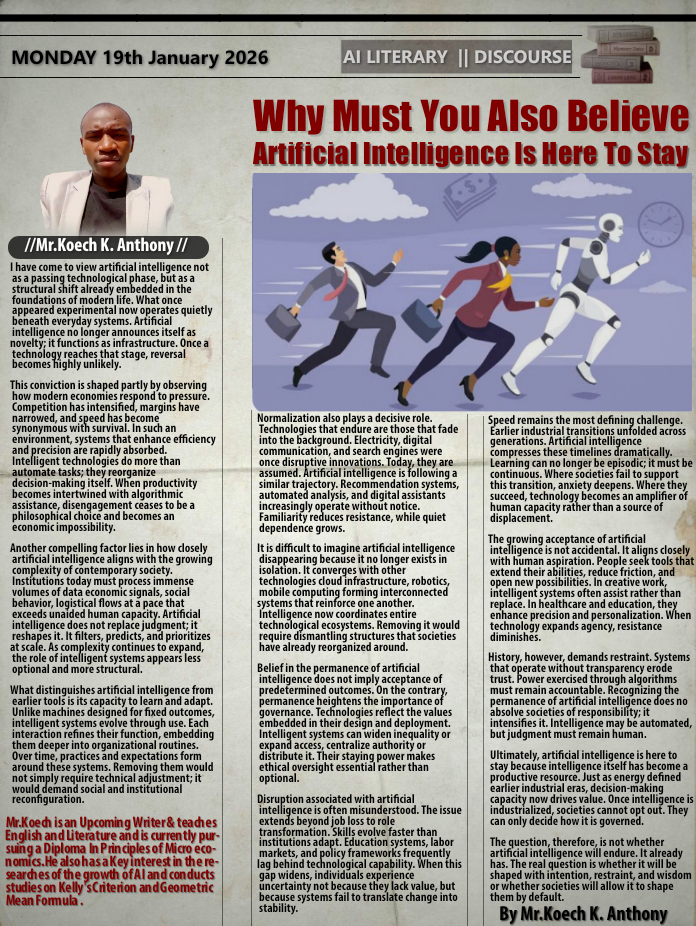
I have come to view artificial intelligence not as a passing technological phase, but as a structural shift already embedded in the foundations of modern life. What once appeared experimental now operates quietly beneath everyday systems. Artificial intelligence no longer announces itself as novelty; it functions as infrastructure. Once a technology reaches that stage, reversal becomes highly unlikely.
This conviction is shaped partly by observing how modern economies respond to pressure. Competition has intensified, margins have narrowed, and speed has become synonymous with survival. In such an environment, systems that enhance efficiency and precision are rapidly absorbed. Intelligent technologies do more than automate tasks; they reorganize decision-making itself. When productivity becomes intertwined with algorithmic assistance, disengagement ceases to be a philosophical choice and becomes an economic impossibility.
Another compelling factor lies in how closely artificial intelligence aligns with the growing complexity of contemporary society. Institutions today must process immense volumes of data economic signals, social behavior, logistical flows at a pace that exceeds unaided human capacity. Artificial intelligence does not replace judgment; it reshapes it. It filters, predicts, and prioritizes at scale. As complexity continues to expand, the role of intelligent systems appears less optional and more structural.
What distinguishes artificial intelligence from earlier tools is its capacity to learn and adapt. Unlike machines designed for fixed outcomes, intelligent systems evolve through use. Each interaction refines their function, embedding them deeper into organizational routines. Over time, practices and expectations form around these systems. Removing them would not simply require technical adjustment; it would demand social and institutional reconfiguration.
Normalization also plays a decisive role. Technologies that endure are those that fade into the background. Electricity, digital communication, and search engines were once disruptive innovations. Today, they are assumed. Artificial intelligence is following a similar trajectory. Recommendation systems, automated analysis, and digital assistants increasingly operate without notice. Familiarity reduces resistance, while quiet dependence grows.
It is difficult to imagine artificial intelligence disappearing because it no longer exists in isolation. It converges with other technologies cloud infrastructure, robotics, mobile computing forming interconnected systems that reinforce one another. Intelligence now coordinates entire technological ecosystems. Removing it would require dismantling structures that societies have already reorganized around.
Belief in the permanence of artificial intelligence does not imply acceptance of predetermined outcomes. On the contrary, permanence heightens the importance of governance. Technologies reflect the values embedded in their design and deployment. Intelligent systems can widen inequality or expand access, centralize authority or distribute it. Their staying power makes ethical oversight essential rather than optional.
Disruption associated with artificial intelligence is often misunderstood. The issue extends beyond job loss to role transformation. Skills evolve faster than institutions adapt. Education systems, labor markets, and policy frameworks frequently lag behind technological capability. When this gap widens, individuals experience uncertainty not because they lack value, but because systems fail to translate change into stability.
Speed remains the most defining challenge. Earlier industrial transitions unfolded across generations. Artificial intelligence compresses these timelines dramatically. Learning can no longer be episodic; it must be continuous. Where societies fail to support this transition, anxiety deepens. Where they succeed, technology becomes an amplifier of human capacity rather than a source of displacement.
The growing acceptance of artificial intelligence is not accidental. It aligns closely with human aspiration. People seek tools that extend their abilities, reduce friction, and open new possibilities. In creative work, intelligent systems often assist rather than replace. In healthcare and education, they enhance precision and personalization. When technology expands agency, resistance diminishes.
History, however, demands restraint. Systems that operate without transparency erode trust. Power exercised through algorithms must remain accountable. Recognizing the permanence of artificial intelligence does not absolve societies of responsibility; it intensifies it. Intelligence may be automated, but judgment must remain human.
Ultimately, artificial intelligence is here to stay because intelligence itself has become a productive resource. Just as energy defined earlier industrial eras, decision-making capacity now drives value. Once intelligence is industrialized, societies cannot opt out. They can only decide how it is governed.
The question, therefore, is not whether artificial intelligence will endure. It already has. The real question is whether it will be shaped with intention, restraint, and wisdom or whether societies will allow it to shape them by default.
This conviction is shaped partly by observing how modern economies respond to pressure. Competition has intensified, margins have narrowed, and speed has become synonymous with survival. In such an environment, systems that enhance efficiency and precision are rapidly absorbed. Intelligent technologies do more than automate tasks; they reorganize decision-making itself. When productivity becomes intertwined with algorithmic assistance, disengagement ceases to be a philosophical choice and becomes an economic impossibility.
Another compelling factor lies in how closely artificial intelligence aligns with the growing complexity of contemporary society. Institutions today must process immense volumes of data economic signals, social behavior, logistical flows at a pace that exceeds unaided human capacity. Artificial intelligence does not replace judgment; it reshapes it. It filters, predicts, and prioritizes at scale. As complexity continues to expand, the role of intelligent systems appears less optional and more structural.
What distinguishes artificial intelligence from earlier tools is its capacity to learn and adapt. Unlike machines designed for fixed outcomes, intelligent systems evolve through use. Each interaction refines their function, embedding them deeper into organizational routines. Over time, practices and expectations form around these systems. Removing them would not simply require technical adjustment; it would demand social and institutional reconfiguration.
Normalization also plays a decisive role. Technologies that endure are those that fade into the background. Electricity, digital communication, and search engines were once disruptive innovations. Today, they are assumed. Artificial intelligence is following a similar trajectory. Recommendation systems, automated analysis, and digital assistants increasingly operate without notice. Familiarity reduces resistance, while quiet dependence grows.
It is difficult to imagine artificial intelligence disappearing because it no longer exists in isolation. It converges with other technologies cloud infrastructure, robotics, mobile computing forming interconnected systems that reinforce one another. Intelligence now coordinates entire technological ecosystems. Removing it would require dismantling structures that societies have already reorganized around.
Belief in the permanence of artificial intelligence does not imply acceptance of predetermined outcomes. On the contrary, permanence heightens the importance of governance. Technologies reflect the values embedded in their design and deployment. Intelligent systems can widen inequality or expand access, centralize authority or distribute it. Their staying power makes ethical oversight essential rather than optional.
Disruption associated with artificial intelligence is often misunderstood. The issue extends beyond job loss to role transformation. Skills evolve faster than institutions adapt. Education systems, labor markets, and policy frameworks frequently lag behind technological capability. When this gap widens, individuals experience uncertainty not because they lack value, but because systems fail to translate change into stability.
Speed remains the most defining challenge. Earlier industrial transitions unfolded across generations. Artificial intelligence compresses these timelines dramatically. Learning can no longer be episodic; it must be continuous. Where societies fail to support this transition, anxiety deepens. Where they succeed, technology becomes an amplifier of human capacity rather than a source of displacement.
The growing acceptance of artificial intelligence is not accidental. It aligns closely with human aspiration. People seek tools that extend their abilities, reduce friction, and open new possibilities. In creative work, intelligent systems often assist rather than replace. In healthcare and education, they enhance precision and personalization. When technology expands agency, resistance diminishes.
History, however, demands restraint. Systems that operate without transparency erode trust. Power exercised through algorithms must remain accountable. Recognizing the permanence of artificial intelligence does not absolve societies of responsibility; it intensifies it. Intelligence may be automated, but judgment must remain human.
Ultimately, artificial intelligence is here to stay because intelligence itself has become a productive resource. Just as energy defined earlier industrial eras, decision-making capacity now drives value. Once intelligence is industrialized, societies cannot opt out. They can only decide how it is governed.
The question, therefore, is not whether artificial intelligence will endure. It already has. The real question is whether it will be shaped with intention, restraint, and wisdom or whether societies will allow it to shape them by default.